Rebranding for a Series B: What Actually Needs to Change
Raising a Series B with a brand that hasn't caught up? Here's what actually needs to change, and what that looks like depending on where you're starting from.
Most brands don’t fail because their logo is bad.
They fail because everything around the logo falls apart the moment they try to grow.
New channels. New markets. New teams. New agencies.
Suddenly the brand starts to drift. Design gets inconsistent. Campaigns feel disconnected. Decisions slow down.
That’s the difference between a logo and a brand system.
A logo is an asset.
A brand system is infrastructure.
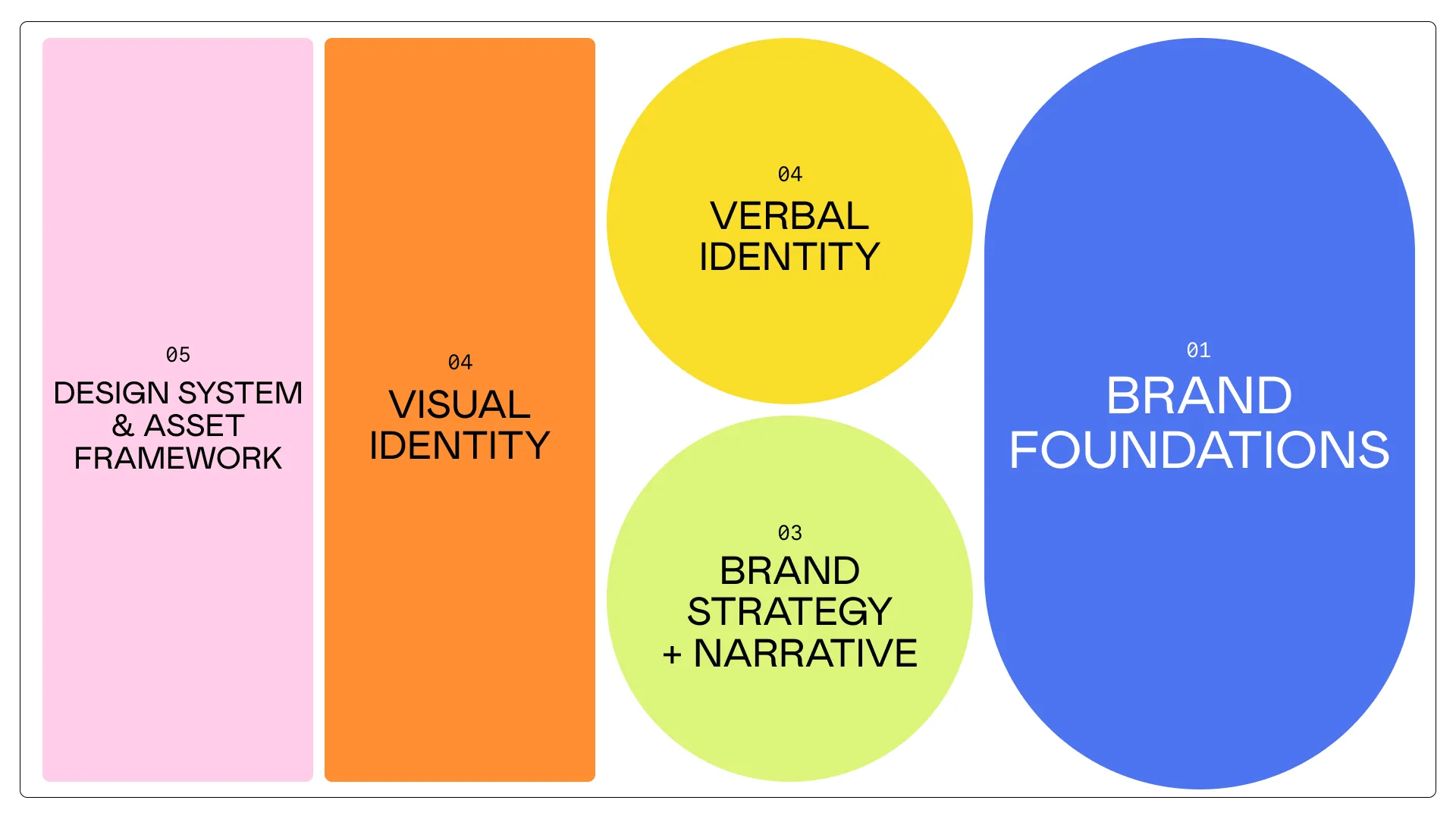
In this post, we’ll break down what a brand system actually is, what elements go into it, and how strong brand systems help ambitious companies scale without losing coherence. We’ve also mapped everything visually in a structured infographic you can reference, share, and build from.
A brand system is the complete set of rules, components, and principles that govern how a brand looks, sounds, and behaves, across every touchpoint.
It’s not just design.
It’s not just messaging.
And it’s definitely not just a logo file in a Dropbox folder.
A proper brand system answers questions like:
In short: a brand system makes consistency scalable.
Brand system vs brand identity (why the distinction matters)
This is where many teams get tripped up.
Brand identity = the visible layer (logo, colours, type, visuals)
Brand system = the operating system underneath it
Think of identity as what people see.
Think of the system as how everything gets made.
Without a system, every new brief becomes a debate.
With a system, decisions are faster, clearer, and easier to delegate, whether you’re working with an in-house team, a design studio, or a creative campaigns agency.
Below is the full structure we use when building brand systems that are designed to scale, organised from strategic foundations through to execution.
This is the strategic layer. Everything else sits on top of it.
Includes:
If this layer is vague, the system won’t hold. No amount of visual polish can fix unclear foundations.
This is where meaning turns into messaging.
Includes:
This layer ensures your website, campaigns, sales decks, and product messaging are all telling the same story, even when written by different people.
Visual consistency gets all the attention. Verbal consistency is what actually builds trust.
Includes:
This is particularly important for brands investing in content, performance marketing, and creative campaigns that need to flex without losing their voice.
This is the part most people think of first, but it works best when it’s built on the layers above.
Includes:
A strong visual system gives designers clarity and confidence, without turning the brand into a rigid template.
This is where brand meets reality.
Includes:
This layer is what allows a design studio or internal team to move quickly without reinventing the wheel every time.
This is where brand systems prove their value.
Includes:
The best systems don’t restrict creativity—they enable better creative campaigns by giving teams a clear starting point and guardrails that make sense.
Brand systems aren’t about control.
They’re about momentum.
They help brands:
This is why scaling brands invest in systems, not just assets.
In practice, brand systems are most valuable when:
If that sounds familiar, you’re already feeling the problem a brand system is designed to solve.
Because this is exactly the thinking behind how we work as a creative agency.
Depending on where a brand is starting from, we support:
Different entry points. Same underlying system thinking.
Brand systems only matter if they hold up in the real world, across packaging, digital, campaigns, content, and culture.
Here are three examples of how we’ve built brand systems for very different businesses, each designed to scale in its own way.
Pastino is a fast-growing fresh pasta brand, bold, playful, and designed to live everywhere from takeaway boxes to social posts to physical spaces.
The challenge wasn’t standing out once.
It was standing out consistently.

Rather than treating each touchpoint as a one-off, Pastino’s brand system was built around:
This allowed the brand to grow quickly without visual chaos, whether on packaging stacks, campaign graphics, or in-store moments.
👉 See the full Pastino brand system case study here
Goolf sits at the intersection of sport, play, and social connection, which meant the brand needed to feel welcoming, distinctive, and adaptable across digital and physical environments.
The challenge here wasn’t loudness.
It was cohesion.

The Goolf brand system focused on:
The result is a brand that feels playful but grounded, and recognisable whether you encounter it on a billboard, a bucket hat, or an app screen.
👉 See the full Goolf brand system case study here
Ding is a digital service brand where clarity isn’t optional, it’s the product.
The brand system needed to do several things at once:

Ding’s brand system was built around:
This system allows Ding to move fast, launching campaigns, product updates and content, without losing clarity or trust.
👉 See the full Ding brand system case study here
People don’t trust brands because they’re loud.
They trust them because they’re consistent.
A logo gets you noticed.
A brand system earns belief.
If you need help building a brand that stands out and a brand system that will stand the test of time, give our team a shout.


